
The Tiered Emergency Fund: Essential Wealth Protection in 2026
THIS ARTICLE MAY CONTAIN AFFILIATE LINKS, MEANING I GET A COMMISSION IF YOU DECIDE TO MAKE A PURCHASE THROUGH MY LINKS AT NO COST TO YOU. PLEASE READ MY AFFILIATE DISCLOSURE FOR MORE INFO.
DON’T HAVE TIME TO READ THE FULL ARTICLE. HERE’S WHAT YOU ARE MISSING.
- The Tiered Emergency Fund: Essential Wealth Protection in 2026
- Rethinking Financial Safety Nets for a Volatile Economy
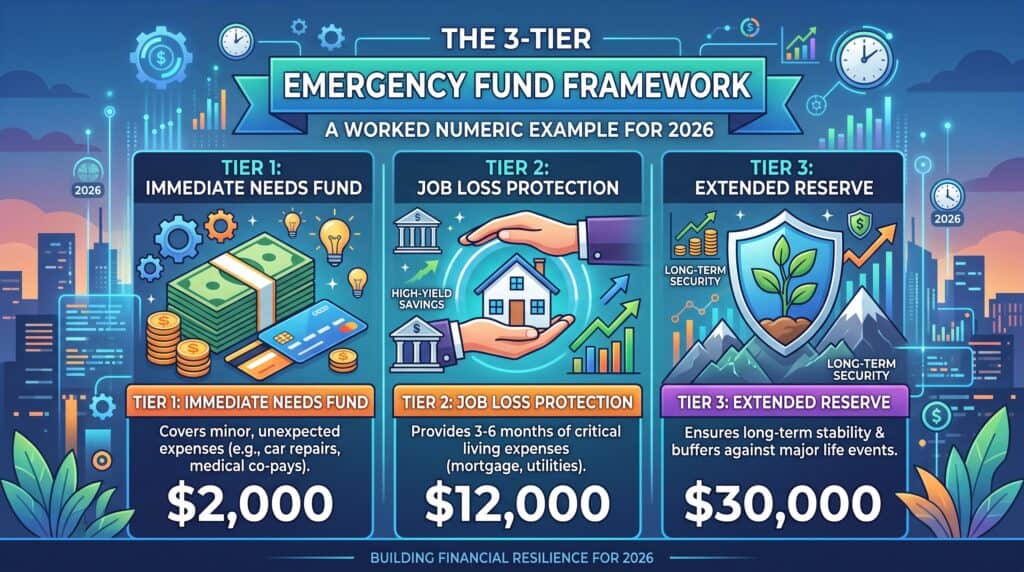
- Understanding the Three-Tier Structure
- Determining the Optimal Amount for Each Tier
- Choosing the Best Accounts and Tools for Each Tier
- Strategies to Build and Maintain Your Fund
- Common Mistakes and How to Avoid Them
- Integrating the Emergency Fund Into Your Wealth-Building Plan
Most people think an emergency fund just means piling cash into one account and hoping for the best. In 2026, that’s not enough—your money ends up either too exposed or earning next to nothing while the economy keeps shifting.
The tiered emergency fund fixes this by splitting your safety net into three layers: immediate cash for urgent stuff, high-yield savings for core protection, and growth-focused assets for extended coverage.

This system came out of the chaos from 2023’s inflation spike and the job market rollercoaster that followed. You need money you can grab in seconds for a car repair, but you also want cash earning 4% interest in case you lose your job.
And then there’s a third layer—something between safety and growth, so you’re not risking your security but you’re not missing out either. The old “3-6 months in savings” rule assumed your job was steady and your bills were predictable.
That’s just not true for most people in 2026. A tiered approach lets you actually tailor your emergency fund to your own risks, your income, and how quickly you could land a new job if you needed to.
Tiered Emergency Fund Key Takeaways
- Split your emergency fund into three tiers based on how fast you’ll need the money
- Keep immediate cash separate from high-yield savings to balance access and earnings
- Build each tier to match your job stability and monthly expenses—ditch the generic advice
Rethinking Financial Safety Nets for a Volatile Economy

The global financial safety net isn’t just about simple savings anymore. You should apply that same thinking to your personal finances in 2026.
Old-school emergency funds took a cookie-cutter approach: stash three to six months of expenses in one account and hope for the best. That only works if your job is rock solid and your bills never change.
The 2026 reality is a different animal:
- Job markets are more specialized, and it takes longer to find new work
- Inflation has settled at 2.5%, but your dollar doesn’t stretch as far
- Savings account interest rates jump around more than ever
- Economic shocks hit faster and with less warning
Strengthening financial safety nets means thinking in layers, not just lump sums. Your emergency fund should pull double duty—accessible when you need it, but working for you in the meantime.
The tiered structure is a lot like how institutions handle emergency liquidity during a crisis. You keep different levels of access, depending on how urgent the need is.
Key advantages of a tiered approach:
- Immediate tier keeps you from racking up overdraft fees or credit card debt
- Core tier earns competitive returns and stays liquid
- Extended tier fills the gap between emergencies and long-term investing
Your money can serve more than one purpose without putting your security on the line. That’s the sweet spot.
Understanding the Three-Tier Structure

Your emergency fund actually works when it matches your real needs. The right structure puts money where you can grab it fast, grows what you rarely touch, and gives the rest a shot at higher returns without big risks.
Immediate Liquidity: Your Fast-Access Buffer
This tier is your smallest, but it’s for your most urgent needs. Keep $1,000—or one month of expenses—in a regular savings account linked to your checking.
The goal is speed, not returns. When your car needs a fix or you get hit with a surprise bill, you want money in minutes, not days.
Banks usually let you move money between linked accounts instantly. You might get only 0.5% to 1% APY here, but that’s fine—access beats interest in this case.
Check your account once a month. If you dip below $1,000, top it up before adding to the other tiers.
High-Yield Core: Maximizing Returns While Staying Flexible
Your second tier holds three months of expenses in a high-yield savings account earning 3.8% to 4.2% APY. This is your main safety net.
These accounts combine decent interest rates with pretty reliable access. You can get your money in about a day—perfect for a job loss or a major home repair.
Key features to look for:
- No monthly fees
- No minimum balance requirements
- FDIC insurance up to $250,000
- Mobile app access
- Unlimited transfers
You’re actually earning something while keeping your money safe. At 4% APY, a $15,000 balance grows by $600 a year. That’s not nothing.
Growth Buffer: Expanding Your Safety Net
Your third tier stretches your coverage past three months. This money sits in accounts that pay higher returns or offer some growth potential, but aren’t as easy to tap immediately.
You might use money market accounts with 4.5% to 5% APY. These sometimes need higher minimums, but the rates are worth it. Withdrawals can take a few days, so you’ll need to plan ahead.
Short-term Treasury bills (4-week or 13-week terms) are another option. They’re government-backed and often pay solid rates, as long as you’re okay waiting for maturity.
Some folks use this tier for conservative bond funds or CDs under a year. That’s fine if you’ve already covered yourself in Tiers 1 and 2.
The amount you keep here depends on your job situation and expenses. Self-employed? You’ll probably want six to nine months across all tiers. Got a steady job? Four or five months might be enough.
Determining the Optimal Amount for Each Tier

Your tier amounts should reflect your real monthly costs and job situation, not just some rule you found online. The right balance depends on what you spend to live and how steady your income is.
Calculating Essential Living Expenses
Start by tracking your actual baseline expenses for a full month. Include rent or mortgage, utilities, groceries, insurance, minimum debt payments, and transportation.
Skip stuff like dining out, streaming, or shopping. In an emergency, you’ll cut those anyway. The idea is to find the bare minimum to keep your household running.
Here’s a quick formula for sizing your tiers:
- Tier 1: $1,000 minimum or two weeks of must-pay expenses, whichever is higher
- Tier 2: 3 months of must-pay expenses
- Tier 3: 2-3 more months of must-pay expenses
If your essential monthly costs are $3,200, your tiers would look like $1,000 (Tier 1), $9,600 (Tier 2), and $6,400–$9,600 (Tier 3). There’s no perfect number, but this gets you close.
Factoring in Income Stability and Job Market Risks
Your employment type shapes whether you need the minimum or maximum tier amounts. W-2 employees in stable industries can stick with the lower range.
Freelancers, commission-based workers, and those in unpredictable sectors should aim for the upper range. Consider these job market risks in 2026:
- Single-income households: Add one extra month to Tier 3
- Specialized roles with limited local opportunities: Maximize all three tiers
- Healthcare or government positions: Use minimum tier amounts
- Tech, real estate, or gig economy work: Add 25% to your calculated totals
If your field usually requires 4-6 months to land a new job, your emergency fund should cover at least six months of expenses. Split this as 15% in Tier 1, 50% in Tier 2, and 35% in Tier 3.
Choosing the Best Accounts and Tools for Each Tier

Each tier needs different account features to do its job. Fast access is everything for Tier 1, while Tier 2 is all about yield.
Tier 3 has to balance growth with reasonable liquidity.
Standard Savings Accounts for Fast Access
Your Tier 1 fund should move money in minutes, not days. A traditional savings account at your main bank works because you can transfer to your checking account instantly or within a few hours.
Most brick-and-mortar banks offer basic savings accounts with 0.01% to 0.50% APY. The low interest is the trade-off for having your cash right there when you need it.
Look for accounts with no monthly fees and no minimum balance. Link this account directly to your checking account.
Set up alerts so you know when funds drop below your target. Some banks offer overdraft protection that moves money from savings if your checking runs low.
Key features to prioritize:
- Same-day or instant transfers
- No withdrawal penalties
- Mobile app access
- ATM card option for emergency cash
The goal here isn’t to earn interest. It’s about having cash ready the moment you need it.
Selecting High-Yield Savings Accounts
High-yield savings accounts for Tier 2 should earn between 3.8% and 4.5% APY as of mid-2026. Online banks like Ally, Marcus by Goldman Sachs, and Discover usually lead with the best rates.
Compare APY rates every month—they change with the Fed. Even a 0.5% difference on $18,000 is $90 more per year.
Check for sneaky fees that can eat your gains—monthly maintenance, withdrawal penalties, or minimum balances. Most accounts for building an emergency fund let you make six withdrawals per month, which is plenty for emergencies.
Transfers to outside banks usually take 1-3 business days.
What to evaluate:
- Current APY and rate history
- FDIC insurance up to $250,000
- Transfer speed to your checking account
- Mobile deposit capabilities
- No monthly fees
Open your HYSA at a different bank than your checking account. That little bit of separation helps you avoid spending it on a whim, but you can still get to it if something big happens.
Evaluating Other Low-Risk Accounts and Cash Equivalents
For Tier 3, it makes sense to look beyond regular savings. You want inflation protection but still need to reach the funds within a few days if needed.
Treasury bills currently yield 4.5% to 5.0% and you don’t pay state income tax on the interest. Series I Savings Bonds adjust with inflation and paid over 9% during the 2022 spike.
The tiered emergency fund strategy using I-bonds requires you to hold them for at least 12 months before you can cash out, so they’re really just for reserves you probably won’t touch.
Money market accounts blend HYSA-level yields with checking-like features—think debit cards and check-writing. Rates usually range from 3.5% to 4.3% APY.
Tier 3 options comparison:
| Account Type | Current Yield | Access Time | Annual Limit |
|---|---|---|---|
| Treasury Bills | 4.5%-5.0% | 1-3 days | None |
| I Savings Bonds | 5.27% (May 2026) | 12+ months | $10,000/person |
| Money Market Accounts | 3.5%-4.3% | Same day | None |
Treasury Direct handles both T-bills and I-bonds, but you’ll need to verify your identity, which can take a few days. Most brokerages like Fidelity and Vanguard make T-bill purchases easier and set up accounts faster.
Money market accounts are handy if you want Tier 3 to double as an extended emergency fund and a place for big purchases. The debit card gives you flexibility, without the year-long lockup of I-bonds.
Strategies to Build and Maintain Your Fund

Building a tiered emergency fund takes steady action and a willingness to adjust as your life and the economy change. You want systems that mostly run themselves, but you also need to stay alert for times when you need to rebalance.
Automating Deposits and Regular Reviews
Set up automatic transfers from your checking to each tier on payday. Start with $50 to $100 per paycheck into Tier 1 until you reach your one-month goal.
After you hit that, redirect those automatic deposits to your HYSA for Tier 2. Many banks let you schedule recurring transfers on certain days, so pick the day after your paycheck clears to move the money before you spend it.
Review your emergency fund every six months. If your monthly expenses climb due to rent, insurance, or a new dependent, you’ll need to boost your fund.
For example, if your costs go from $4,000 to $4,500 a month, add $1,500 to your three-month Tier 2 reserve.
Adjusting for Inflation and Economic Changes
Inflation chips away at your fund’s value, even when rates seem steady. At 2.5% annual inflation in 2026, a $12,000 emergency fund loses about $300 in real value each year if it’s not growing.
Check your HYSA rate every quarter against what’s out there. If you’re getting 3.8% APY but you could get 4.2% elsewhere, moving banks adds $48 a year on a $12,000 balance. That adds up over time.
When the Fed changes rates, HYSA yields usually move within a few weeks. During rate cuts, consider if tiered emergency fund strategies using Treasury securities make sense for Tier 3.
Keep an eye on job market conditions in your industry. If layoffs rise or hiring slows, focus on building Tier 2 to six months of expenses instead of just three.
Common Mistakes and How to Avoid Them

Plenty of people trip up on emergency funds in the same ways. Here’s what to look out for—and how to dodge these pitfalls.
Mixing Emergency Money with Regular Savings
Don’t lump your vacation fund in with job loss protection. Keep separate accounts for each goal. Only dip into your emergency fund for real emergencies: medical bills, car trouble, or losing income.
Choosing the Wrong Account Type
Some folks leave Tier 2 cash in a regular savings account earning 0.5% APY instead of a HYSA at 4.0%. That’s $350 lost per year on $10,000. Always compare rates before you pick where to stash your cash.
Building Tiers in the Wrong Order
Fund Tier 1 first—get your $1,000 for instant access. Then work on your HYSA for three months of expenses. Only after that should you look at Tier 3 options.
Not Adjusting for Life Changes
The emergency fund you built in 2024 might not cut it in 2026. Review your tiers twice a year. Did you get a raise? Have a baby? Move somewhere pricier? As your monthly expenses change, your fund should grow too.
Treating Low APY Like It Doesn’t Matter
Interest differences are real money. On $15,000, a 3.5% gap means $525 more a year. Don’t be afraid to move your money when better rates pop up.
Integrating the Emergency Fund Into Your Wealth-Building Plan

Your emergency fund isn’t just some separate stash. It’s the foundation that makes everything else possible, honestly.
Think of your tiered emergency fund as the bedrock for your entire investment strategy. With liquid reserves to cover immediate needs and three months of expenses in high-yield savings, you can invest more confidently.
You get to take bigger swings in your retirement accounts without that nagging fear of needing to pull out money in a crunch.
The Integration Framework:
- Build Tier 1 first before adding extra to your 401(k).
- Fund Tier 2 while still grabbing your employer match.
- Start Tier 3 once you’re putting at least 15% of your income toward retirement.
- Rebalance quarterly as your income or expenses shift.
Your emergency tiers run alongside your investment timeline. Short-term goals—under two years—belong in Tier 2 or 3.
Medium-term goals, say two to five years out, can shift into conservative investments after you’ve finished building your emergency fund.
The tiered approach to emergency funds gives you natural checkpoints. When Tier 1 is ready, you’ve got immediate security. Tier 2 done? Now you can boost your investment contributions.
By the time Tier 3 is built, you’re in a spot to try advanced strategies like tax-loss harvesting or maybe even real estate investing, if that’s your thing.
Keep your emergency fund separate from your investment accounts. Seriously, use a different bank or at least label the accounts clearly.
This separation helps you avoid dipping into your safety net when markets get bumpy and that “buy the dip” urge hits.
Your emergency fund shields your investments. It keeps you from making those painful, forced withdrawals during downturns.
If you are ready to take the next step in your financial journey, explore our other articles in the series or create visual trackers for your savings goals.
Series Part 4: The Silent Wealth Killer: Defeating Lifestyle Creep in 2026
SERIES PART 5. MASTER MINDSET SHIFTS FOR FINANCIAL SUCCESS, DEFEAT LIFESTYLE CREEP, APPLY THE 50% RAISE RULE, AND AUDIT DIGITAL LEAKS WITH THE 2026 WEAL
Disclaimer: Millennial Credit Advisers is not a licensed credit service provider or financial advisor. We don’t offer credit repair, debt management, or legal services. Educate yourself on saving, reducing debt, and managing credit for economic improvement. Understand credit reports, scores, and financial products. Consult a financial advisor for personalized advice. Track your progress for a better credit journey.
Written content – “Please view our full AI Use Disclosure.
“We improve our products and advertising by using Microsoft Clarity to see how you use our website. By using our site, you agree that we and Microsoft can collect and use this data. Our privacy policy has more details.”