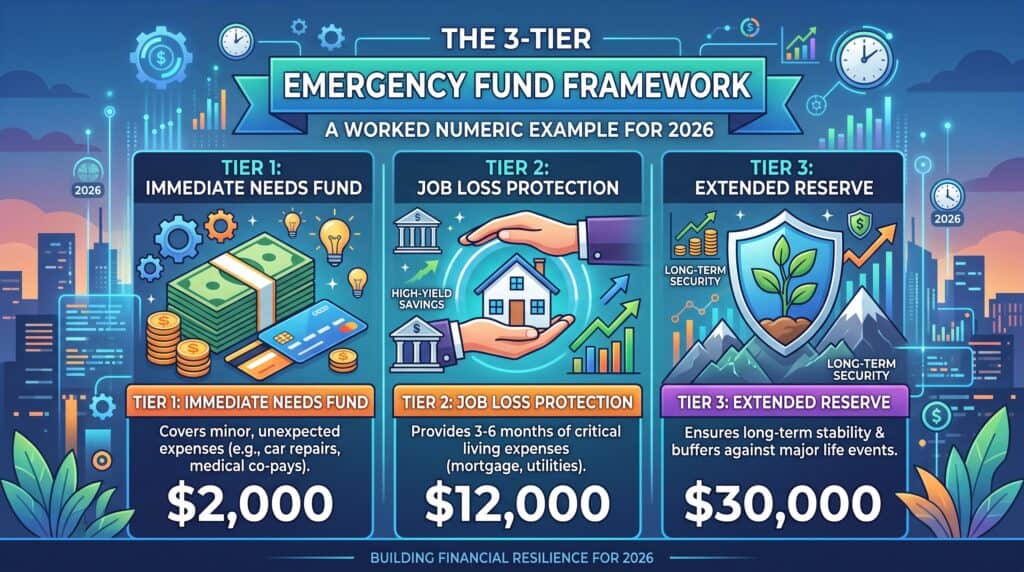
The 3-Tier Emergency Fund Framework: A Worked Numeric Example for 2026.
THIS ARTICLE MAY CONTAIN AFFILIATE LINKS, MEANING I GET A COMMISSION IF YOU DECIDE TO MAKE A PURCHASE THROUGH MY LINKS AT NO COST TO YOU. PLEASE READ MY AFFILIATE DISCLOSURE FOR MORE INFO.
Classic financial advice suggests saving “three to six months of living expenses.” We strongly agree with that advice, as it has helped millions of consumers avoid financial hardship.
For consumers facing the realities of inflation, variable income, and rising housing costs in 2026, throwing a massive lump sum into a single checking account is inefficient.
Here’s what we’re sharing: a strong safety net needs a solid structure to be truly effective.
This guide explains the 3-Tier Emergency Fund Framework with a clear, step-by-step example.
It shows how to divide income among checking accounts, high-yield savings (HYSA), and stable cash options to earn the most interest while keeping money immediately accessible.
Four FREE Giveaways
- Avoid the “Lump Sum” Trap: Storing your entire emergency fund in a standard checking account loses purchasing power to inflation daily.
- The 3-Tier Structure: Divide your fund into Immediate (Tier 1), Mid-Term (Tier 2), and Long-Term (Tier 3) buckets to balance accessibility with yield.
- Calculate Based on Needs, Not Income: Your target number should be based on core living expenses (housing, food, transportation, insurance), not your gross salary.
- Optimize Yield with T-Bills: Tier 3 of your emergency fund can leverage stable cash equivalents like Treasury Bills or Certificates of Deposit (CDs) to combat inflation without risking principal.
The Problem with the Standard Advice
When you’re told to save up to six months of expenses, the natural inclination is to keep it where you can see it—usually the savings account linked directly to your primary checking.
According to a 2026 report by the Federal Reserve, the national average interest rate for traditional savings accounts remains notoriously low, often well under 0.50%. Meanwhile, inflation constantly erodes the purchasing power of that cash.
Where Should You Put Your Money?
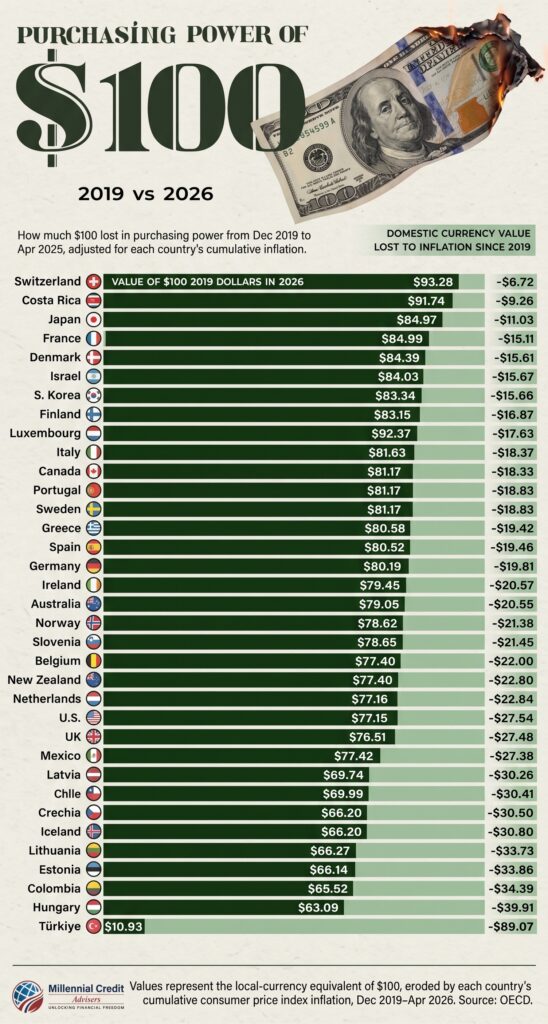
The Cost of Inflation. For Educational Purposes.
The goal of an emergency fund isn’t to make you rich, but it shouldn’t make you poorer through stagnation. You need a system that protects you from life’s disasters while protecting your cash from inflation.
The 3-Tier Emergency Fund Framework Explained
The 3-Tier framework segments your savings based on when you would realistically need the money in a crisis.
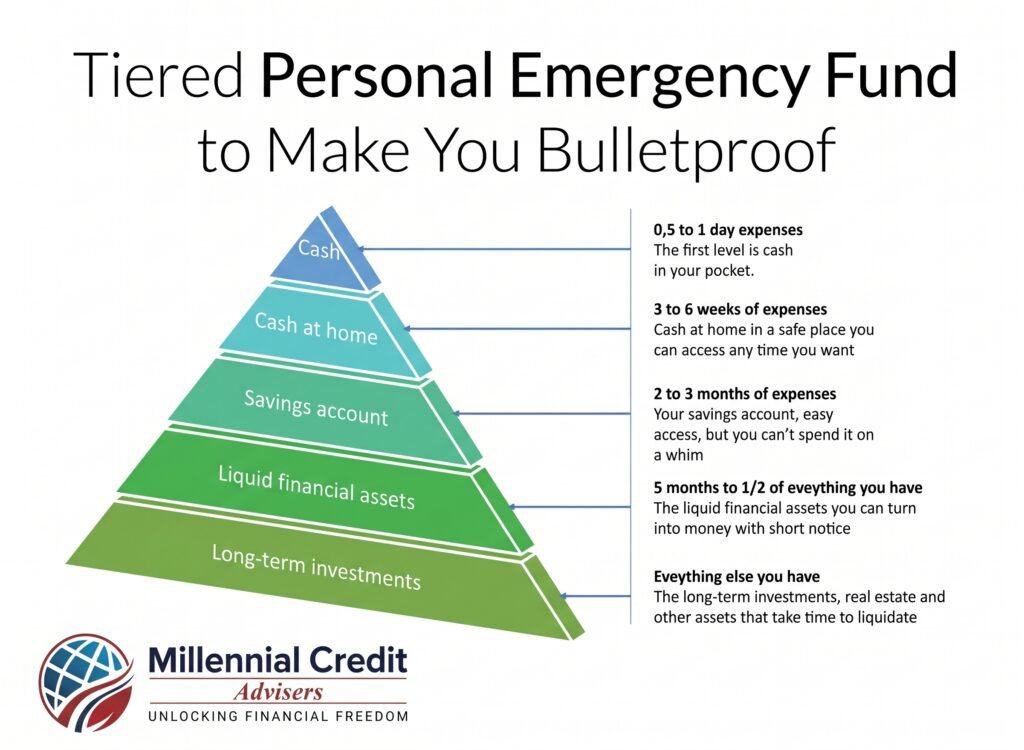
The Tiered Approach. For Educational Purposes.
Tier 1: The “Right Now” Fund (0-1 Month)
- Where it lives: A buffer in your primary checking account.
- Purpose: To prevent overdraft fees, handle immediate minor emergencies (a flat tire, a quick trip to urgent care), and ensure you can pay rent tomorrow even if payroll is delayed.
- Liquidity: Instant.
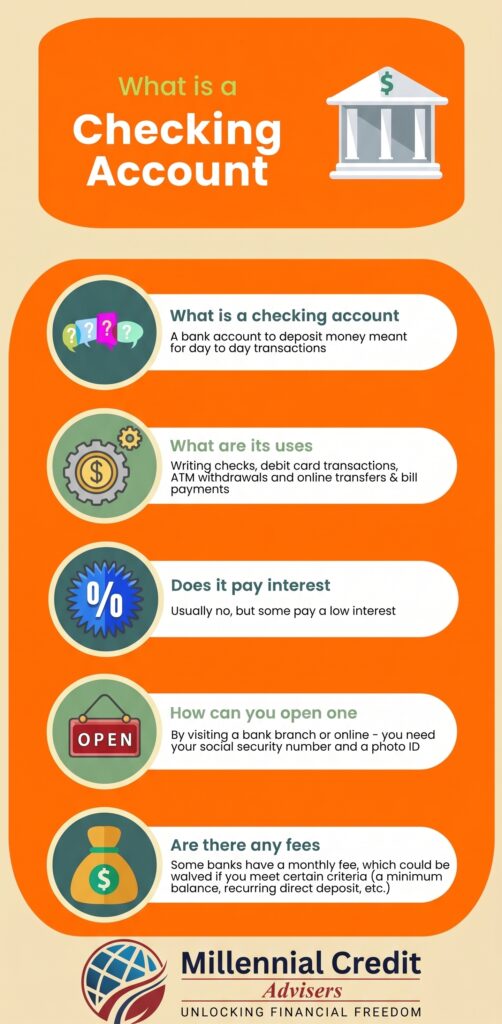
Tier 1: High Liquidity. For Educational Purposes.
Tier 2: The “Next Few Months” Fund (1-3 Months)
- Where it lives: A High-Yield Savings Account (HYSA), preferably at a different institution than your checking account to create slight friction against impulse spending.
- Purpose: To cover expenses during a moderate disruption, such as a temporary job loss, major car repair, or sudden medical deductible.
- Liquidity: 1 to 3 business days (ACH transfer time).
Tier 2: The Power of Compound Interest. Source: Ally. For Educational Purposes.
Tier 3: The “Major Crisis” Fund (3-6+ Months)
- Where it lives: Stable cash equivalents like short-term Treasury Bills (T-Bills), No-Penalty Certificates of Deposit (CDs), or a Money Market Fund.
- Purpose: To sustain you through a prolonged job loss or severe medical crisis. This tier focuses on maximizing yield while remaining accessible within a week.
- Liquidity: 2 to 7 business days. For Educational Purposes.
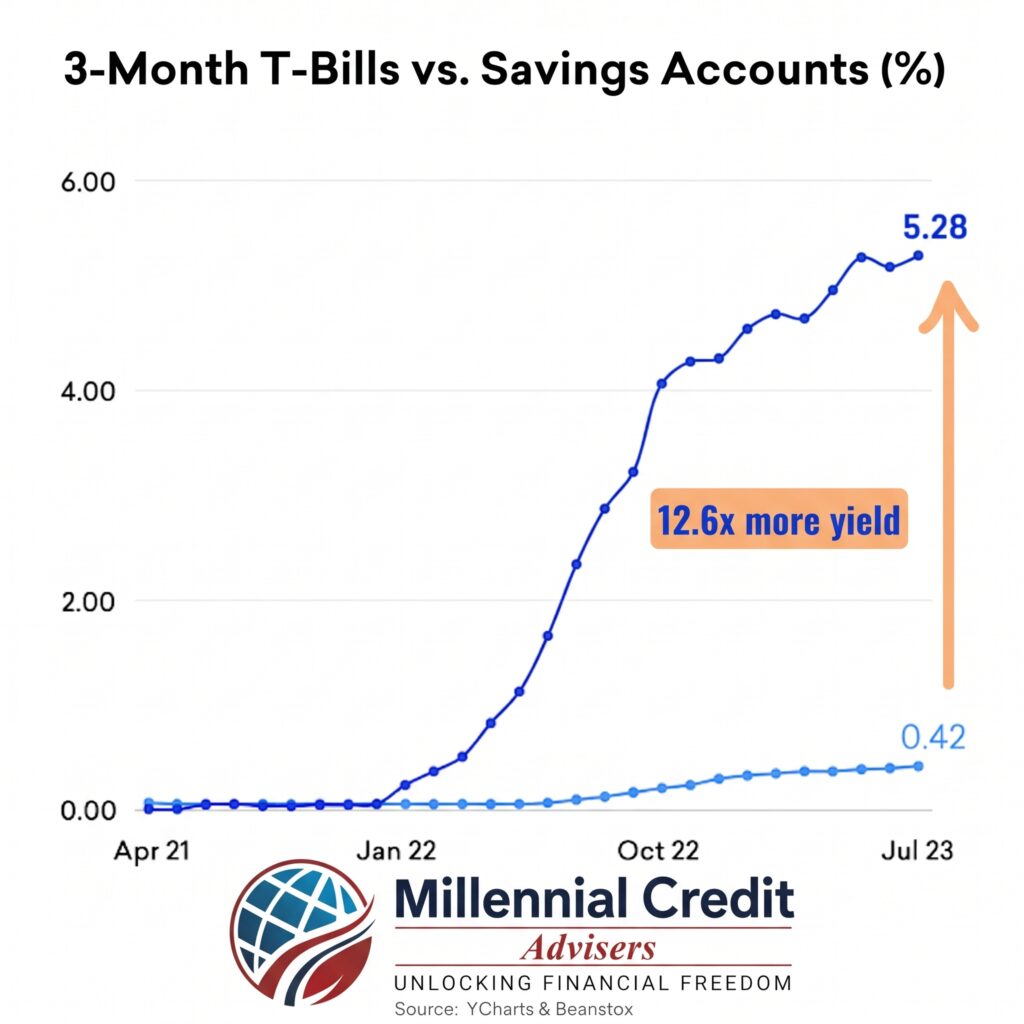
Tier 3: Maximizing Yield. For Educational Purposes.
A Worked Numeric Example: The Millennial Profile
Let’s look at how this works in practice for a hypothetical 30-year-old millennial, Sarah. Before setting up her tiers, Sarah needs to calculate her “bare-bones” monthly expenses. This is what she needs to survive, not her current comfortable lifestyle.
Calculate Your Baseline. Source: Millennial Money. For Educational Purposes.
Step 1: Calculating the Baseline
According to data from the Bureau of Labor Statistics, housing and transportation are the largest expense categories for single adults.
Sarah’s Bare-Bones Budget (Monthly):
- Rent & Utilities: $1,600
- Groceries: $400
- Car Payment & Insurance: $450
- Minimum Debt Payments (Student Loans/Credit Cards): $300
- Health Insurance (if unemployed): $250
- Total Monthly Baseline: $3,000
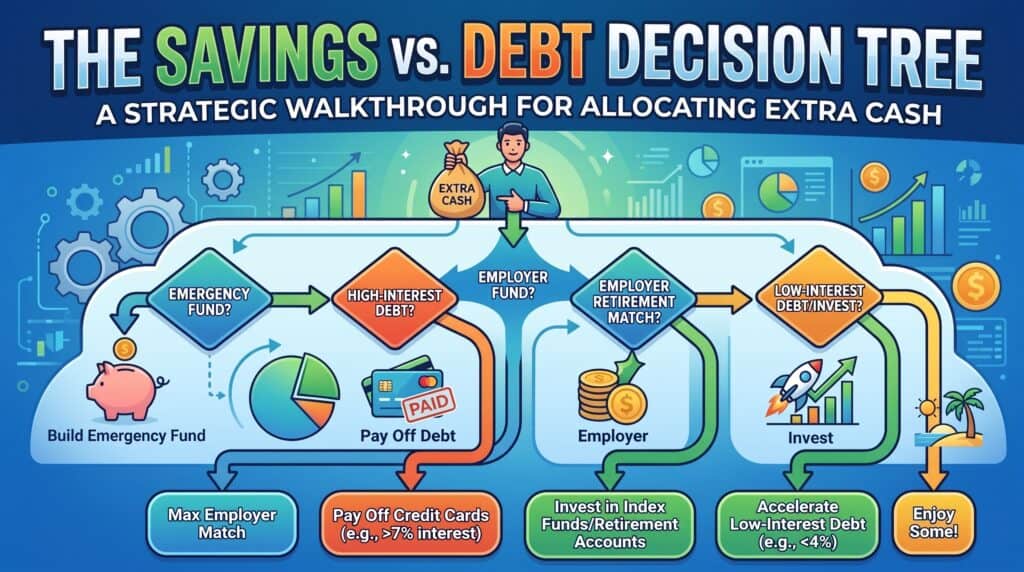
Note: If you have high-interest credit card debt, review our guide on The Debt vs. Savings Decision Tree before fully funding a 6-month tier.
Step 2: Structuring the Tiers
Sarah decides on a conservative 6-month total emergency fund goal, meaning she needs to save $18,000 ($3,000 x 6).
Here is the exact allocation table based on the 3-Tier Framework: For Educational Purposes.
| Tier | Duration | Goal Amount | Account Type | Expected APY (Est. 2026) |
|---|---|---|---|---|
| Tier 1 | 1 Month | $3,000 | Primary Checking (Buffer) | 0.00% |
| Tier 2 | 2 Months | $6,000 | High-Yield Savings (HYSA) | 4.50% |
| Tier 3 | 3 Months | $9,000 | 3-Month or 6-Month T-Bills/CDs | 5.25% |
| TOTAL | 6 Months | $18,000 |
Step 3: The Scenario Walkthrough
Let’s see the framework in action during a crisis. Sarah is unexpectedly laid off.
- Week 1: Her severance check is delayed. Rent is due tomorrow. She uses Tier 1 (Checking Buffer) to pay her $1,600 rent immediately without stress or overdraft fees.
- Month 2: She is still looking for a job. She logs into her HYSA and transfers funds from Tier 2 to her checking account, covering that month’s $3,000 baseline expenses. It takes 2 days to clear, but she planned ahead.
- Month 4: The job hunt is taking longer than expected. She logs into her brokerage and liquidates a portion of her Tier 3 T-Bills or waits for a short-term CD to mature, moving those funds down to Tier 1 to continue covering expenses.
Because she tiered her savings, the $9,000 sitting in Tier 3 was earning a higher yield for the four months she didn’t need it, combating inflation far better than if all $18,000 had been sitting in a standard checking account.
Your Action Plan: The Tiering Template & Checklist
If you are starting from zero, do not try to fund all three tiers at once. Follow this setup checklist.
- Calculate Your Baseline: Use the method above to find your exact bare-bones monthly number. For help tracking expenses, refer to our Ultimate Quick Start Guide to Budgeting In Five Easy Steps.
- Fund Tier 1 First: Stop all extra investing and aggressively save until you have exactly one month of expenses sitting as a permanent buffer in your checking account.
- Open a Separate HYSA: Research online banks offering competitive APYs. Do not link a debit card to this account. This will house Tier 2.
- Automate Tier 2: Set up automatic deposits on payday to fund Tier 2 until you hit your 2-month goal.
- Build Tier 3 (Advanced): Once Tier 1 and Tier 2 are fully funded, begin routing excess cash into stable equivalents like T-Bills or CDs. You can buy T-Bills directly through TreasuryDirect.gov.
The Setup Checklist
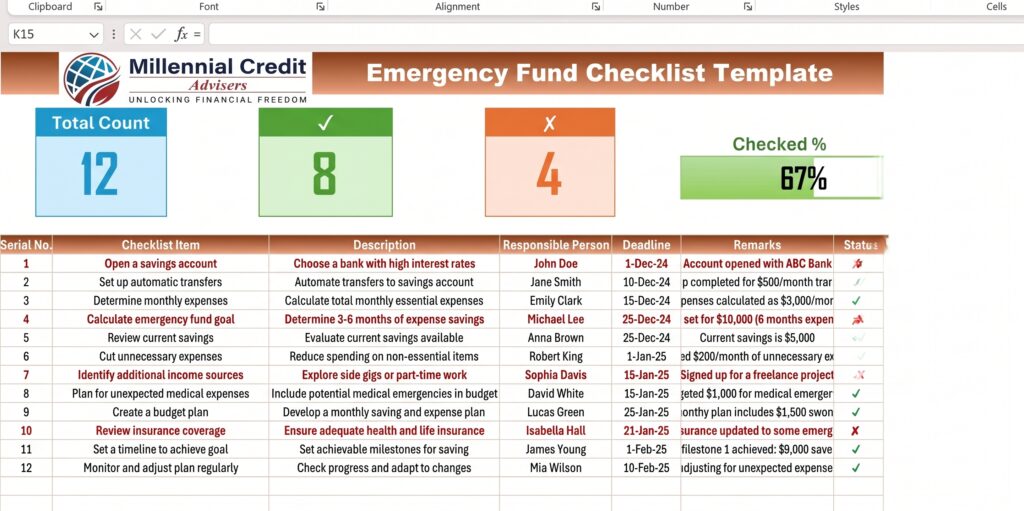
Track Your Progress. For Educational Purposes.
Automate Your Deposits. For Educational Purposes.
Tracking your progress visually can help you stay motivated during the long process of funding a 6-month safety net.
.
Monitor Your Progress. For Educational Purposes.
Why You Need This Now
Relying on credit cards for emergencies is a mathematical trap. With average credit card interest rates exceeding 24%, a $3,000 emergency put on plastic can quickly spiral, damaging your credit utilization and costing you thousands in interest.
Avoid the Debt Trap. Statista. For Educational Purposes.
By implementing the 3-Tier Framework, you build a resilient financial wall between you and high-interest debt, ensuring that an emergency remains an inconvenience, not a catastrophe.
For strategies on managing your credit while building savings, explore our resources on credit scores and reporting.
Last reviewed: September 20, 2026. Expert reviewer: Kravitz, CPA, consumer lending compliance specialist.
Disclaimer: The information provided in this article is for educational purposes only and does not constitute financial or legal advice. Please consult with a qualified professional for personalized guidance.
Written content – “Please view our full AI Use Disclosure.”
We improve our products and advertising by using Microsoft Clarity to see how you use our website. By using our site, you agree that Microsoft and we can collect and use this data. Our privacy policy has more details
Frequently Asked Questions
1. Should I fund my emergency tiers before paying off student loans?
It depends on the interest rate. You should absolutely fund Tier 1 (the one-month buffer) before aggressively tackling any debt. If your student loans have a low interest rate (e.g., under 5%), it is mathematically sound to fund Tier 2 while making minimum payments on the loans. If you have high-interest private loans, you may want to aggressively pay those down after securing Tier 1.
2. Is a Money Market Account (MMA) better than an HYSA for Tier 2?
They are very similar. MMAs often come with debit cards or check-writing privileges, which can make the money tooaccessible. HYSAs often enforce transfer limits, which can be a helpful psychological barrier against impulse spending. Choose the one that offers the best APY with the fewest fees.
3. What happens if I need the money in Tier 3 before the CD or T-Bill matures?
If you buy a standard CD and break it early, you will typically pay a penalty (often a few months of interest). This is why “No-Penalty CDs” are recommended for Tier 3. T-Bills can be sold on the secondary market before maturity through a brokerage, though their value may fluctuate slightly based on current interest rates.
4. I have variable income (freelance/commission). Does the 3-to-6-month rule still apply?
If you have a variable income, you face higher financial risk. Financial planners generally recommend aiming for the higher end of the spectrum—6 to 9 months, or even 12 months—for your total emergency fund. Your Tier 3 will be larger than someone with a stable, salaried position.
5. How often should I recalculate my baseline expenses?
You should review your bare-bones budget annually, or immediately following a major life change such as moving, having a child, or paying off a significant debt (like a car loan). If your expenses increase, your tier targets must increase proportionally.